Choosing a hospitality table starts with room measurements, guest circulation and service routines—not a catalogue photograph. By the end, you can define the right dimensions and shape, compare construction and mechanisms, test finish performance, and give a Delhi manufacturer a purchase specification that is safe to approve.
Key takeaways
- Calculate tables from required seats, chair clearance and service circulation.
- Choose table shapes and bases that fit your service pattern.
- Specify top, edge, frame and hardware together for reliable performance.
- Test cleaning, moisture resistance and stability before approving production.
Start with the Floor Plan, Guest Count and Service Route
Calculate table quantity from the required seats, then test that arrangement against the floor plan and service route. Do not divide room area by tabletop area: chairs, pull-out space, guest circulation, wheelchair access and waitstaff movement determine the usable footprint. Reserve a clear path from kitchen, pantry or bar to every table.
Measure these figures before selecting hotel table dimensions:
- Guest count: write the maximum simultaneous covers, not average occupancy. Divide that number by the table seating capacity and round up. Add separate tables for buffets, registration, bars or service stations.
- Table footprint: include the tabletop, chairs and at least 900 mm behind occupied chairs. Keep main service aisles near 1,200 mm, and provide a 1,500 mm turning area where wheelchair users must turn.
- Hospitality table sizes: allow about 600 mm of table edge per seated guest. A 1,800 mm rectangular table commonly seats six comfortably; a 1,200 mm round table commonly seats four to six, depending on chair width and service style.
- Service route: draw a continuous route from the service point to each table. Remove any layout that forces staff behind seated guests, blocks fire exits or narrows accessible circulation.
- Banquet table layout: test straight runs, U-shapes and chevrons using the actual modular lengths. State the joining gap and include connectors or alignment pins when tables must form a continuous surface.
For a restaurant, calculate covers per seating period as well as total seats. For a banquet, calculate the largest programmed room setup, then confirm the same tables fit smaller events without wasting circulation space.
Match the Table Shape and Base to the Operation
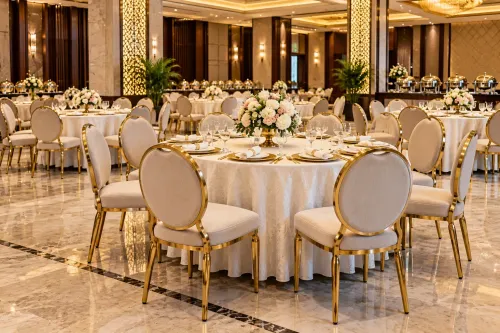
Choose the table that matches how guests, staff and layouts move: round hotel tables support conversation and flexible seating; rectangular banquet tables create straight runs, U-shapes and chevrons; square restaurant tables reconfigure in pairs; café communal tables maximise shared seating while preserving service access.
| Shape | Base | Mechanism and best use |
|---|---|---|
| Round hotel tables | Central pedestal | Frees legroom and prevents chair clashes; suits dining rooms, weddings and conversation-led seating |
| Rectangular banquet tables | Folding legs with anti-racking bracing | Packs efficiently and joins into straight runs, U-shapes or chevrons |
| Square restaurant tables | Four-leg or central pedestal base | Combines into larger layouts while retaining two- and four-person settings |
| Café communal tables | Central stretcher or pedestal base | Supports shared seating; choose cable management and stable feet for continuous daily use |
For changing event layouts, require a positive mechanical lock in both the open and stored positions. Test each table while loaded, inspect hinges and nesting points for pinch hazards, and specify connectors, alignment pins or linking clips with the permitted joining gap. A spring catch that is hard to verify visually is a safety weakness.
Ask for a complete-table cyclic test covering the top, edge, fasteners, frame and folding mechanism. For hotel and banquet use, state the intended EN 15372 severity level and require the supplier’s test report; “heavy duty” is not a performance rating.
Specify the Top, Edge, Frame and Hardware as a System
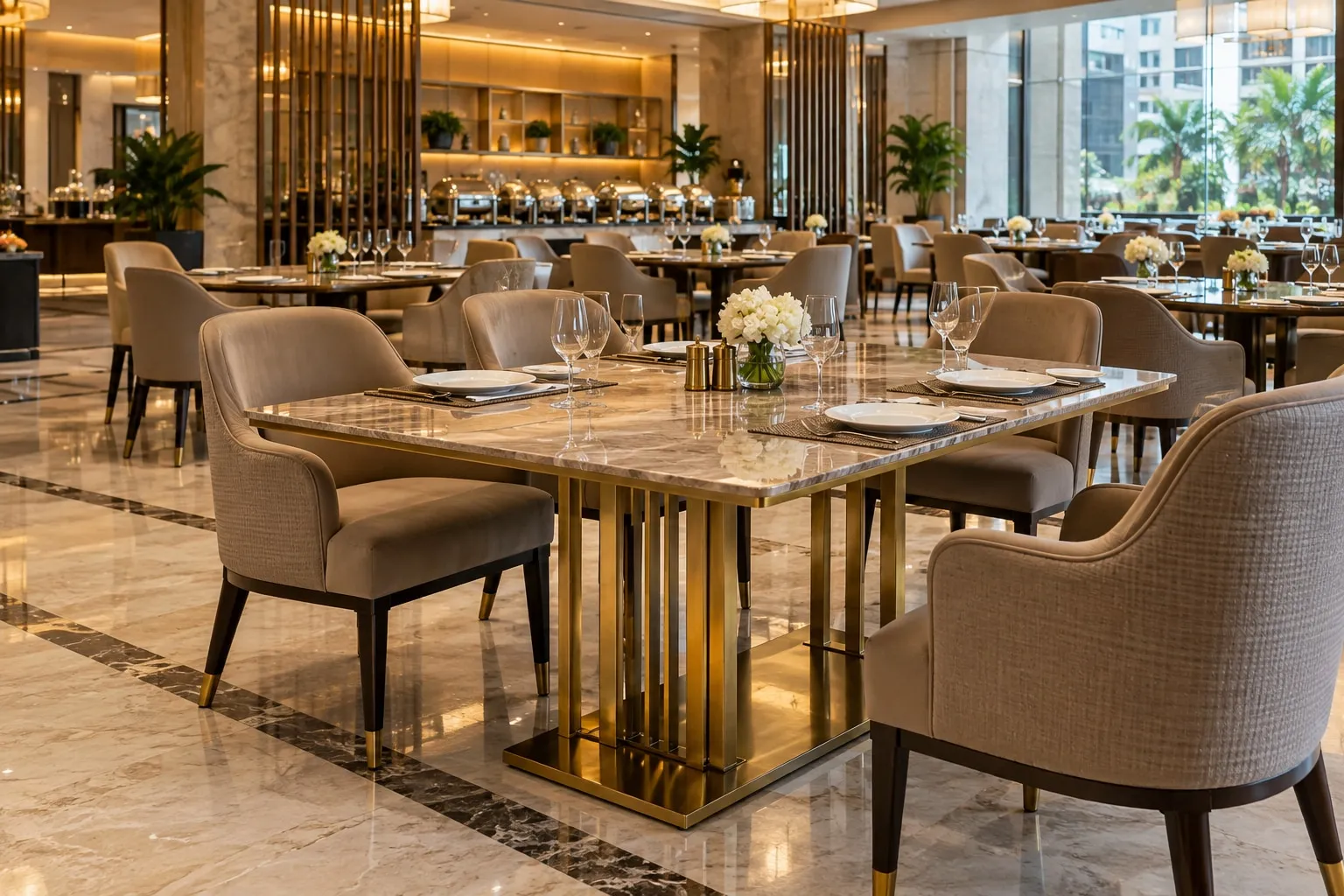
A commercial table is a system, not a tabletop placed on legs. Compare the top, edge, commercial table frame, fasteners and folding mechanism together; a table that passes a static load test can still loosen under dragging, leaning, uneven floors and trolley impacts.
| Feature | Option or detail to compare | What to verify |
|---|---|---|
| Top surface | Laminate versus veneer | Laminate resists routine abrasion and spills; veneer offers a natural finish but needs a durable sealed coating. |
| Core | Plywood or composite board | Name the grade and standard: IS 303 covers general-purpose plywood, while IS 710 covers marine plywood. Neither proves finished-table performance. |
| Edge | PVC, solid timber or replaced strip | Check impact resistance, sealed joints and whether damage can be repaired without replacing the top. |
| Frame | Welded steel tube or bolted frame | Request tube size, wall thickness, anti-racking bracing, joint access and a stated load limit. |
| Folding hardware | Hinge, latch and locking leg | Check positive locks, pinch-point protection, replaceable feet and the required opening-and-closing cycles. |
For banquet tables, frame and folding hardware often determine service life more than nominal top thickness. Specify cyclic testing of the complete table, including fasteners, edge, frame and mechanism, and request a report to EN 15372 for non-domestic tables at the intended severity level.
- Removable top and replaceable edge strips
- Standard fasteners, spare feet and folding-leg assemblies
- Touch-up material and access to replacement parts
- Coating coupons tested against alcohol sanitiser, quaternary-ammonium disinfectant, bleach dilution, acidic residue and hot serving equipment
Test Cleaning, Moisture, Stability and Repeated Use Before Ordering
Do not approve a sample because it survives a weight placed at the centre. Hotel service adds dragging, leaning, trolley impacts, uneven floors, wet cleaning and repeated folding, so test the complete table rather than the tabletop alone.
1. Request a hotel table durability test to EN 15372 tables requirements. Specify the intended severity level and obtain the supplier’s test report for strength, durability and stability; “heavy duty” is not evidence.
2. Run cyclic tests with the top, edge, fasteners, frame and folding mechanism assembled. Drag, load and unload the table repeatedly, then inspect loosened joints, wobble, cracked edges and distorted legs.
3. Match samples to your commercial table cleaning routine. Test alcohol sanitiser, quaternary-ammonium disinfectant, diluted bleach, acidic food residue and hot serving equipment, then request a written table chemical resistance schedule covering the coating, laminate, adhesive and edge.
4. Test moisture at the vulnerable points: exposed edges, underside, cut-outs and fixing penetrations. Apply standing water for a defined period, wipe it using the cleaning procedure, and reject swelling, bubbling, staining or softened adhesive.
5. Open and fold or nest the table under load. Require a positive lock in both positions, visible confirmation of engagement and anti-pinch protection at hinges; identify plywood by standard, such as IS 303 or IS 710, rather than accepting “commercial plywood” alone.
Record the test load, cycles, chemicals, exposure times and pass criteria in the purchase specification. resubmit.
Turn the Specification into a Delhi Manufacturing and Approval Checklist
Before approving hotel table manufacture in Delhi, demand a signed checklist covering performance, sample approval, delivery condition and service support.
1. State the intended EN 15372 severity level for non-domestic tables and require the supplier’s test report. “Heavy duty” is not a test result.
2. Approve a full-size production sample. Record dimensional tolerances, corner radius, underside access, leg alignment, level adjustment, edge-impact resistance, stain removal, packaging damage and locally available replacement hardware.
3. Name every material and standard. If plywood is specified, identify IS 303 general-purpose plywood or IS 710 marine plywood; then record the finished table’s edge sealing, abrasion, stain and load requirements.
4. For banquet, folding or nesting tables, record leg-tube size, wall thickness, anti-racking bracing, hinge design, replaceable feet and the required opening-and-closing cycle count. Test a positive lock in both open and stored positions with the table loaded, and inspect anti-pinch protection at hinges and nesting points.
5. Write the hotel table warranty and spare parts schedule into the purchase order. Include removable tops, replaceable edge strips, standard fasteners, spare feet, folding-leg assemblies, touch-up material, response times and exclusions.
Give this document to each Delhi hospitality furniture manufacturer, including The Comfort Seatings, and compare written evidence rather than showroom claims. Reject any design that requires replacing the complete table after one damaged leg.
Frequently asked questions
How do you calculate the number of hotel tables needed?
Start with the required seat count, then test table quantities against chair pull-out space, guest circulation, wheelchair access and staff service routes. Do not divide the room area by tabletop area.
Which table shape and base suits a hospitality operation?
Use square or rectangular tables for efficient layouts and flexible joining, round tables for social seating, and bases that preserve legroom and resist tipping. Match the choice to service routes, table movement and the venue’s seating pattern.
What should a hotel table specification include?
Specify the tabletop material and thickness, edge profile, frame, base, fasteners, glides, finish and moisture protection as one system. Record dimensions, load expectations, approved samples and cleaning requirements.
How should you test hotel tables before placing a manufacturing order?
Check stability, chair clearance, moisture exposure, cleaning with the venue’s products, edge durability and repeated movement. Run the tests on a production-intent sample before approving the full batch.