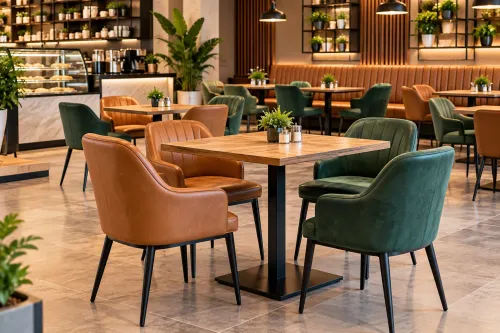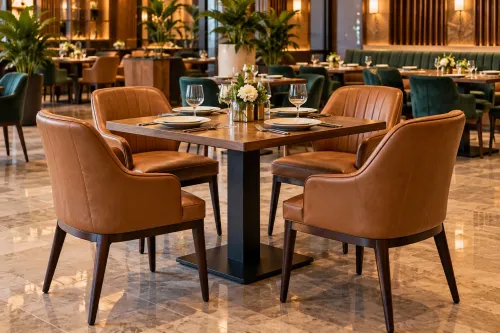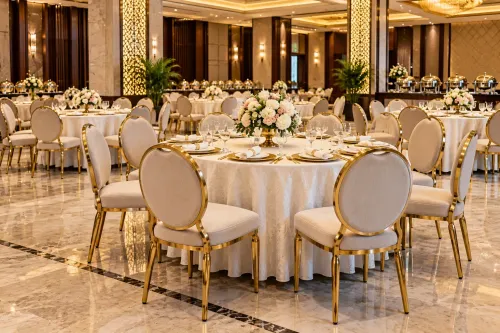
A banquet sofa must fit the event format, dining table, circulation plan and delivery route before comfort or appearance becomes useful. By checking dimensions, ergonomics, upholstery, construction and testing documents, you can compare options and approve a sofa that works through long functions and frequent venue changeovers.
Key takeaways
- Use 1,200–1,800 mm modular sofas for flexible event layouts.
- Measure tables, doorways, lifts and the full delivery route before ordering.
- Specify seat depth, cushion firmness and back support for long functions.
- Request upholstery specifications, frame details and commercial test evidence.
Match the Sofa to Your Event Format and Seating Plan
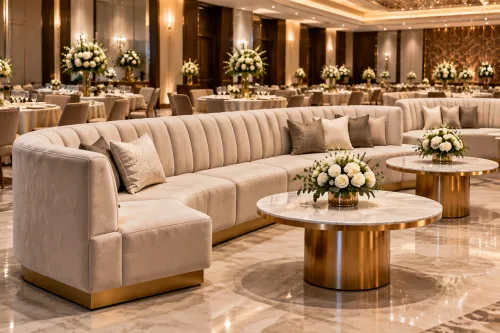
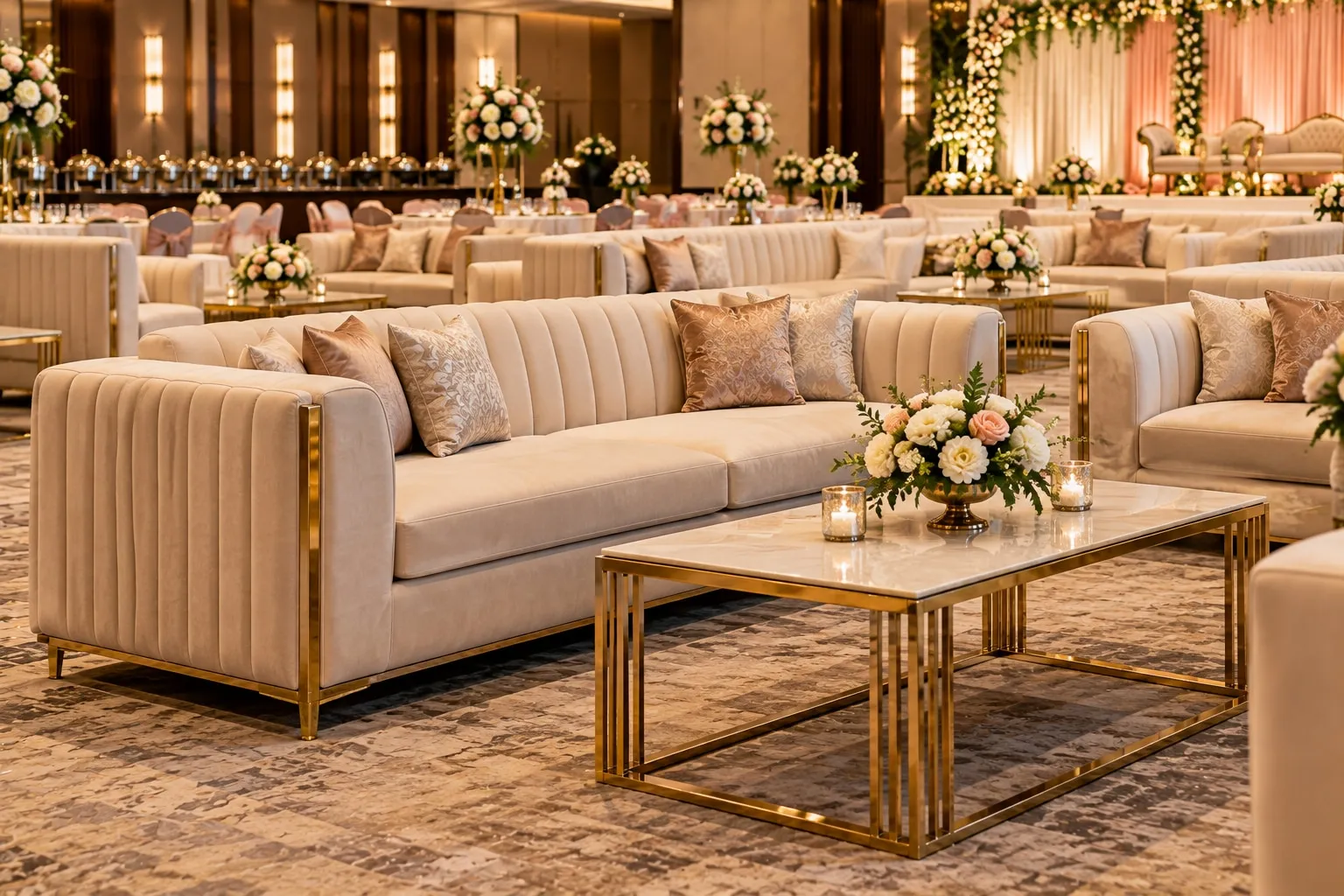
A banquet sofa suits wedding seating, dining function seating, lounge areas and waiting zones where guests value comfort and the layout does not change repeatedly. Choose 1,200–1,800 mm modular units for flexible floor plans; narrower modules limit the number of seats lost when one cushion or frame needs repair.
| Format or layout | Banquet sofa fit | More practical alternative |
|---|---|---|
| Wedding seating | Works along perimeter walls, sweetheart-table areas and grouped dining tables | Banquet chairs suit frequent table changes and larger guest counts |
| Conference seating | Fits informal breakout zones and rear lounge rows | Chairs with writing tablets suit note-taking, presentations and tight row spacing |
| Dining function seating | Works with fixed tables when seat height and arm width leave legroom | Armless banquet chairs suit rapid service, close table spacing and easy reconfiguration |
| Lounge or waiting area | Suits reception clusters, registration zones and relaxed conversation | Armchairs or modular lounge seating suit separated groups and quieter privacy |
A fixed three-seat sofa is not automatically more efficient than three banquet chairs: it is harder to reposition, store and carry through narrow access routes. For a banquet sofa in Greater Noida, check the occupied footprint, including knees, handbags and pushed-back bodies, rather than its catalogue outline; staff need a clear serving path.
Use a two-seater settee when you need smaller groups, while modular seating is better when the plan changes between ceremonies, meals and dancing.
Measure the Room, Table and Delivery Route Before Ordering
A catalogue width proves little if the sofa cannot pass the service entrance or leaves no room for diners to move. Measure the room, furniture relationship and complete delivery route before approving the banquet sofa dimensions.
1. Mark the sofa’s full footprint on the floor, including arms and the clearance behind its back. Record overall width, depth, back height and occupied depth. Measure stage clearance separately so the sofa does not obstruct steps, curtains, sightlines or equipment access.
2. Measure the actual banquet table, not a standard drawing. Dining tables are commonly 730–760 mm high. Start with a seat height of 430–460 mm and seat depth of 480–540 mm, then check that the arms and seat slide far enough under the table without striking legs or removing usable knee room.
3. Measure the route from loading bay to final position: loading-bay restrictions, door clear openings, lift-car width, depth and height, stair turns, corridor widths and the smallest corridor pinch point. Compare these figures with the packed and assembled sofa. Knock-down backs or separable arms can solve access problems that a lower price cannot.
4. Mark table spacing, service paths, storage space and the sofa’s pushed-back position. Test whether guests can pull away, and whether staff can pass beside or behind them without blocking an aisle. Record the clearance from the stage, walls and emergency exits before ordering.
Specify Comfort for Long Functions and Different Guests
Judge a comfortable banquet sofa with a timed trial, not a 30-second showroom sit. Ask older guests, shorter guests and taller guests to sit through a meal-length test; overly soft cushions make standing difficult, while a sharp front rail or hard arm edge creates pressure points.
Specify the dining ergonomics against the actual banquet table, which is commonly 730–760 mm high:
- Seat height: approximately 430–460 mm
- Seat depth: approximately 480–540 mm
- Back angle: approximately 100–105 degrees
- Front edge: rounded and pressure-free
- Arm height and width: low enough to let the sofa slide under the table without reducing legroom
A depth above roughly 560 mm can force shorter guests to perch forward, leaving an unusable gap behind their backs. Measure the occupied footprint too: knees, handbags and pushed-back bodies need space for guests to leave while staff serve.
Calculate sofa seating capacity from usable cushion width, not the nominal number of seats. A fixed three-seat sofa may waste flexibility when one cushion or frame is damaged; 1,200–1,800 mm modular units are easier to reposition, while narrower modules limit the number of seats taken out of service during repairs.
Ask for seat foam density and hardness separately. A starting commercial specification is about 32–40 kg/m³ high-resilience or moulded seat foam and 24–32 kg/m³ back foam, followed by sample approval for compression and recovery. Density alone does not prove softness, support or durability.
Choose Upholstery and a Base for Greater Noida Conditions
Choose a commercial-grade, sealed covering and a protected base: Greater Noida’s dust, hot sun, monsoon humidity, spills and repeated relocation punish decorative lounge materials. Approve the actual banquet sofa upholstery under the venue’s lighting and ventilation, not from a catalogue photograph.
| Option | Best fit | Main risk |
|---|---|---|
| Commercial polyester fabric | A fabric sofa with stain-resistant seating for frequent events and softer feel | Dark or heavily textured cloth shows dust and compression shading; uncoated natural fabric absorbs spills |
| Commercial PVC leatherette | A leatherette sofa needing fast wipe-clean maintenance | It can become hot or tacky beside glazed façades; inspect cracking and colour change after cleaning |
| Protected metal or sealed hardwood base | High-turnover halls where staff drag and clean seating repeatedly | Exposed mild steel can rust; unsealed timber absorbs moisture |
Request abrasion data for the complete upholstery fabric. Use 30,000–50,000 Martindale cycles or higher as a screening figure, not a guarantee against stains, fading, pilling or seam damage.
If the venue specifies BS 5852, CAL 117 or EN 1021, verify the ignition source, test method, specimen construction and certificate applicability. The evidence must cover fabric, foam, batting and backing; a fabric-only pass does not certify the finished sofa.
Specify non-marking replaceable glides, accessible tightening points and no small hard casters that roll on tile or damage stone.
Inspect the Sample, Construction and Commercial Test Evidence
Do not approve a sample because it looks level and feels soft. A proper commercial sofa inspection checks the hidden structure, records measurable specifications and confirms that test documents apply to the complete upholstery assembly.
1. Photograph the sample from every side, then record overall width, seat height, seat depth, arm height and cushion gaps. Sit on each position, check recovery after standing and note any rocking, squeaking or uneven support.
2. Ask for seat and back foam density and hardness as separate figures. Use the supplier’s stated specification, such as 32–40 kg/m³ seat foam and 24–32 kg/m³ back foam, but approve comfort through the sample because density alone does not prove softness or recovery.
3. Inspect frame construction underneath and behind removable panels. Look for secure joints, reinforced corners, straight rails, firmly fixed legs and clean welds or fasteners; record the frame material, leg finish and load rating.
4. Request fire evidence for fabric, foam, batting and backing together. For BS 5852, CAL 117 or EN 1021, verify the exact test method, ignition source, specimen construction, report number and certificate applicability. A fabric-only pass does not prove the finished sofa passes.
5. Request complete-fabric abrasion results, using 30,000–50,000 Martindale cycles as a screening benchmark, not a guarantee against stains, fading or seam failure.
Ask The Comfort Seatings to attach these records, approved sample photographs and any agreed tolerances to the purchase order. Reject substitutions without written approval.
Frequently asked questions
How do you match a banquet sofa to an event format?
Use 1,200–1,800 mm modular units for flexible floor plans, and assess whether the sofa suits dining, lounge, waiting or fixed wedding seating.
What measurements should you take before ordering banquet sofas?
Measure the room, table clearance, doorways, lifts, corridors and every turn along the delivery route.
How do you specify comfort for long functions and different guests?
Check seat depth, seat height, cushion firmness, back support and arm height against the duration of use and the guests you expect.
Which upholstery and base suit Greater Noida conditions?
Compare cleanability, abrasion resistance, colour stability, moisture tolerance and base materials against venue traffic, spills and local conditions.
What should you inspect in a banquet sofa sample?
Inspect frame joints, cushion recovery, stitching, upholstery attachment, base stability and documented commercial test evidence.