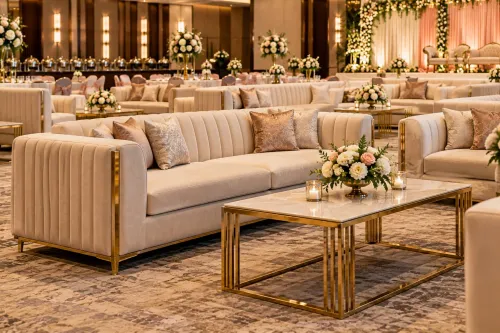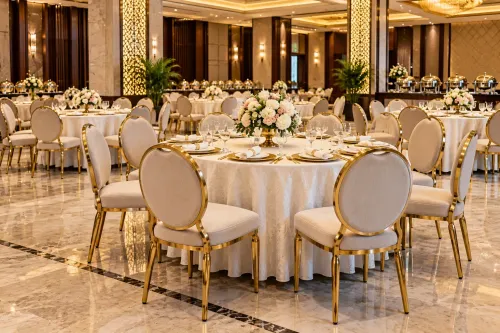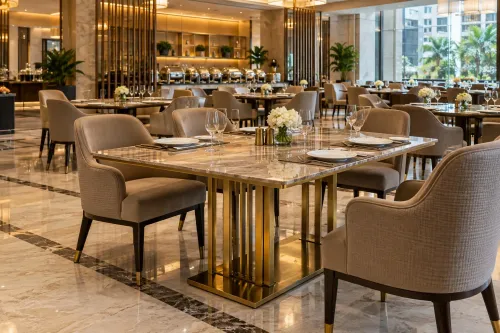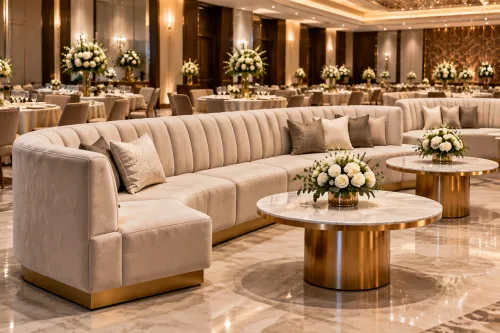
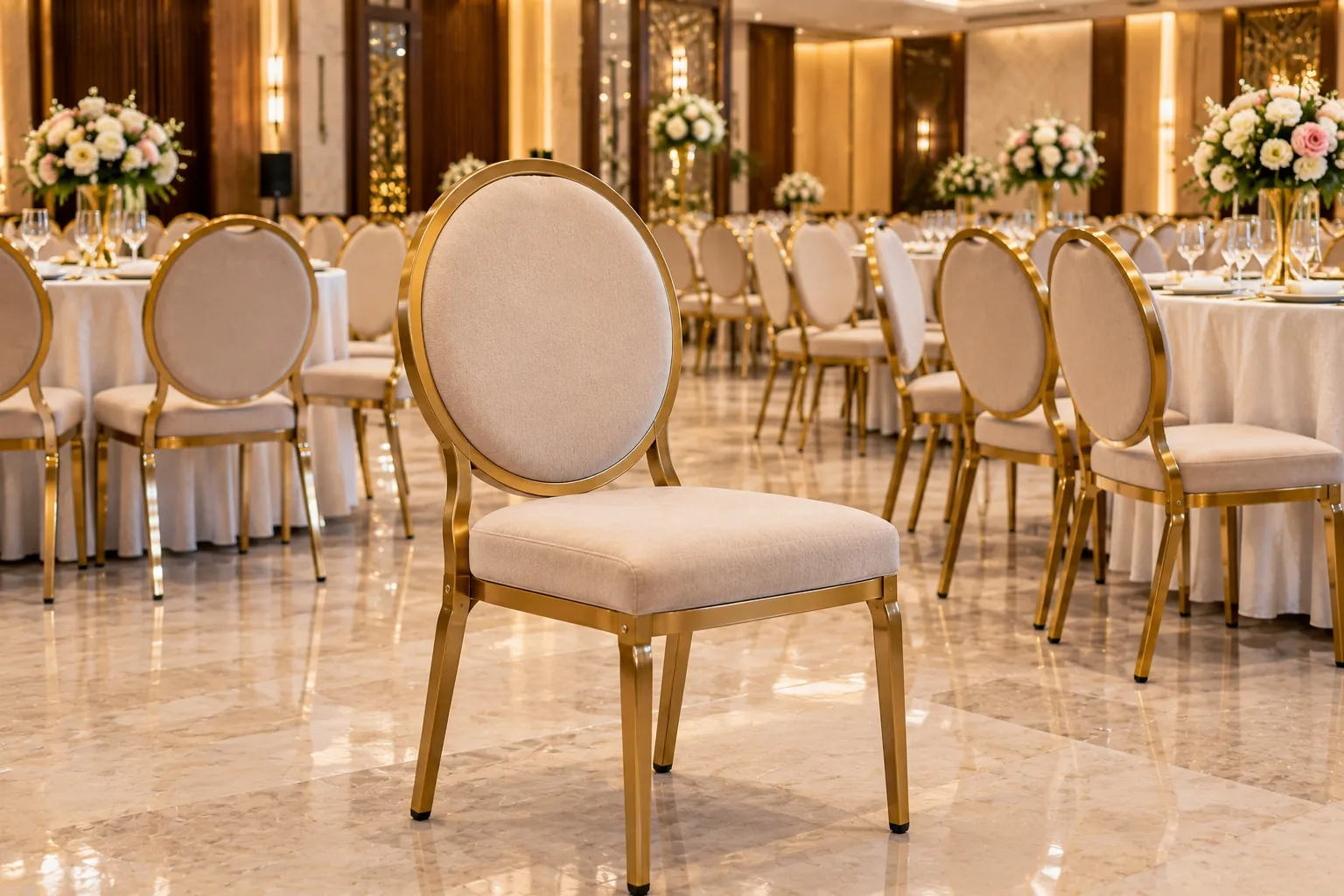
A banquet chair must stay comfortable through a two- to four-hour event, survive repeated handling and fit the venue’s tables, aisles, storeroom and cleaning routine. Use the checks below to compare Kirti Nagar suppliers, test a showroom sample and approve a chair that works in daily operations rather than only in a catalogue photograph.
Key takeaways
- Test a chair for two to four hours and check for pressure points.
- Inspect welded joints, seat foam, upholstery seams and frame finish.
- Request product specifications, warranty terms, invoices and test documents.
- Approve one physical sample before ordering the full banquet chair quantity.
How to Judge Comfort Before You Buy
A comfortable banquet chair supports the body for two to four hours without creating pressure points or forcing guests into one position. Check the physical sample, not just photographs: banquet chair comfort depends on how the seat, backrest, foam and frame work together.
| Feature | Comfortable choice | Warning sign |
|---|---|---|
| Seat width | Enough room for normal posture and small position changes | Hips touch the sides or guests sit on the edge |
| Seat depth | Supports most of the thigh while leaving space behind the knees | Too deep for shorter users, or too short for taller users |
| Front edge | Rounded, padded edge with even pressure | Sharp edge pressing under the thighs |
| Backrest | Contoured support with a slight reclining angle | Flat, rigid back that pushes the shoulders forward |
| Foam and upholstery | Resilient foam with breathable, non-slippery covering | Foam bottoms out or fabric traps heat |
| Seat height | Seat height for banquet tables around 450–480 mm | Feet dangle or knees strike the table apron |
Confirm the final height against the selected table, because a 750-mm tabletop can still offer poor knee clearance when its frame is deep or low. Casters, glides and floor level also alter the sitting position.
Ask each tester to sit, shift position, cross and uncross their legs, and rest their back. Reject a chair that rocks, pinches the thighs or loses support when the guest moves.
What to Inspect in the Frame and Upholstery
A chair that survives frequent banquet service shows strength at its joints, not merely a high advertised load rating. Ask for the frame material, tube diameter and wall thickness, then inspect welds for continuous, even beads without pinholes, sharp craters or visible cracks. Push the back and seat sideways; movement at a joint signals trouble.
Check each sample for:
- Legs that sit evenly on a flat floor, with no rocking, twisting or uneven weld distortion.
- Seat-to-frame joints that stay tight when you lift, lower and rotate the chair.
- Fasteners that remain accessible for tightening, with locknuts or thread-locking treatment where specified.
- Glides that are firmly retained and do not drag, split or fall out during movement.
- Stack bumpers or spacers that prevent back frames, legs and upholstery from rubbing.
- A stated maximum stack tested with the intended trolley; physically push that stack across a floor and watch for sway, catching or frame contact.
Inspect the upholstery as a working surface, not a showroom finish. Run your hand over seams and corners for loose thread, exposed staples, puckering and thin spots, then press the seat repeatedly to detect foam collapse or a hard frame edge. Thick foam alone does not prove banquet chair durability.
If fire performance matters, request evidence for the complete chair construction, including foam, barrier, adhesive and cover. EN 1021-1 covers a smouldering cigarette; EN 1021-2 covers a small flame. A fabric-only certificate is not enough.
Which Standards and Documents Should the Supplier Provide?
Ask for a test report naming ANSI/BIFMA X5.4 or EN 16139, the exact chair configuration, test level, test methods and pass/fail results—not a catalogue user-weight rating.
| Evidence | What it must identify | Why it matters |
|---|---|---|
| ANSI/BIFMA X5.4 report | Public or institutional chair model, configuration, loads, repeated-use tests and results | Shows performance against a recognised commercial seating regime |
| EN 16139 report | Non-domestic chair model and category: normal use or more severe use | Confirms the chair was tested for the intended operating severity |
| Load statement | Whether the user-weight rating means recommended user mass, design load or laboratory test load | A stated weight alone does not prove repeated-impact durability |
| Fire report | Finished upholstery assembly tested to fire performance EN 1021: EN 1021-1 for a smouldering cigarette or EN 1021-2 for a small flame | Fabric-only evidence does not cover the actual foam, barrier, adhesive and cover |
Require the supplier to attach the report to the quoted model, since a test on another frame or upholstery build does not transfer automatically. Ask for upholstery test results tied to your cleaning regime; a Martindale or double-rub figure does not prove resistance to disinfectant, oil, stains, hydrolysis or seam opening.
For reconfigurable halls, request linking-device test evidence in both engaged and stowed positions, plus its replacement method. Approve a physical stack and trolley trial, because a catalogue stack count does not show whether projecting frames or upholstery cause damage.
How to Plan Rows, Stacks and Storeroom Handling
Start with the room’s usable dimensions, not its gross floor area. Record banquet layout dimensions after excluding columns, doors, stages and service zones. Allow table clearance around each table, then reserve an aisle width of at least 900 mm for guest movement; use wider aisles where chairs face busy service routes.
1. Count seats per table and multiply by the number of tables. Add spare chairs for replacements, but store only the quantity staff can move safely. Measure one loaded stack, including its trolley, and calculate stack quantity as total chairs divided by chairs per stack, rounded up.
Record the actual stacking height, because armrests, projecting backs and thick upholstery reduce the catalogue figure.
2. Mark one complete row on the floor with tables, chairs and aisles. Check knee clearance against the table apron, not just a nominal 750 mm table height. A 450–480 mm seat height often suits banquet tables, but deep aprons or glides can change the fit.
3. Time two staff members stacking, loading and unloading one trolley. Multiply that time by the number of stacks and add walking time between the hall and storeroom. Approve the physical stack-and-trolley trial only when chairs remain stable, do not scrape upholstery, and linking devices fold or stow without snagging.
How to Compare Kirti Nagar Suppliers and Approve a Sample
Approve a supplier only after the physical sample passes the same handling, cleaning and storage tasks your venue will perform. A banquet chair supplier Kirti Nagar buyers can audit must confirm dimensions, stack height, trolley fit, installation method, delivery quantity and replacement parts in writing.
- Complete the showroom sample inspection on a flat floor: check dimensions, rock the chair, inspect every weld, tighten or test fastener retention, and verify aligned legs and glides.
- Stack and unstack a representative quantity, then load the actual trolley. Armrests, projecting backs, thick upholstery and non-nesting legs can reduce the catalogue stack count.
- Apply your planned diluted bleach, quaternary disinfectant or alcohol cleaner to a deliberately stained sample. Approve the complete fabric, backing, thread, foam and adhesive assembly at the stated concentration.
- Request the named ANSI/BIFMA X5.4 or EN 16139 test level, configuration and pass/fail report; do not treat a user-weight rating as a durability load.
- Record delivery confirmation, unloading responsibility, installation charges, lead time for replacement parts, link replacement, and the contact who handles damaged units.
Supplier comparison | Evidence to approve | Warning sign Stacking | Physical stack and trolley trial | Catalogue count only Support | Written delivery, installation and replacement terms | Verbal assurance Linking | Engaged and stowed operation tested | Permanently projecting link The Comfort Seatings should be assessed by this same evidence, not by its catalogue photographs.
Related products
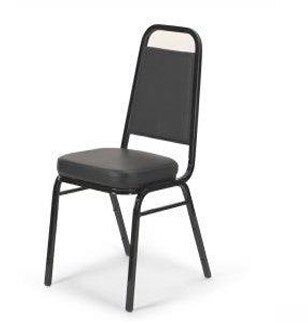 | Banquet Chair Enhance the elegance of your event spaces with premium-quality banquet chairs from The Comfort Seating. View product → |
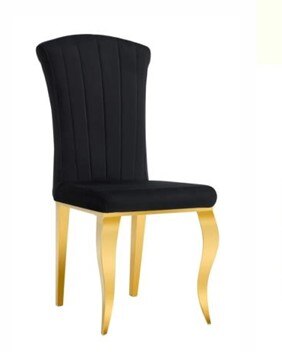 | Banquet Chair At The Comfort Seating, we focus on both aesthetics and functionality. View product → |
Cleaning, Maintenance and Alternatives for Different Venues
Clean spills immediately; dried food and oily marks become harder to remove and can damage upholstery. Banquet chair cleaning should follow the approved fabric procedure: vacuum seams, use the specified diluted solution, blot rather than scrub, and dry the seat completely. Never soak foam, because trapped moisture causes odour, mildew and corrosion.
Before adopting bleach, quaternary disinfectants or alcohol-based products, obtain approval for the complete assembly: fabric, backing, thread, foam, adhesive and cleaning concentration. A high Martindale or double-rub result does not prove chemical resistance. Upholstery maintenance also means checking opened seams, loose fasteners, damaged glides and bent frames during scheduled inspections.
Choose another chair type when the venue’s cleaning demands or visual brief outweigh upholstered comfort.
| Option | Better choice when | Main trade-off |
|---|---|---|
| Polypropylene banquet chairs | Frequent spills and rapid wipe-downs dominate | Less padded comfort |
| Chiavari chairs | Weddings require a formal, lightweight appearance | Poorer choice for long seated events |
| Upholstered banquet chairs | Guests sit for several hours | More demanding cleaning and drying |
Frequently asked questions
How can you judge banquet chair comfort before buying?
Sit on the physical sample for an extended period and check seat depth, back support, foam firmness, pressure points and whether the chair forces one posture.
What should you inspect in a banquet chair frame and upholstery?
Check welded joints, frame alignment, load-bearing parts, surface finish, foam recovery, stitching, seams and upholstery attachment points.
Which documents should a banquet chair supplier provide?
Ask for a written specification, invoice, warranty terms, care instructions and any available material or performance test documents that match the supplied model.
How should banquet chairs be planned for rows, stacking and storage?
Confirm row spacing for the venue, set a safe stacking limit, measure stacked height and width, and reserve a dry storeroom route that staff can handle safely.
Related products
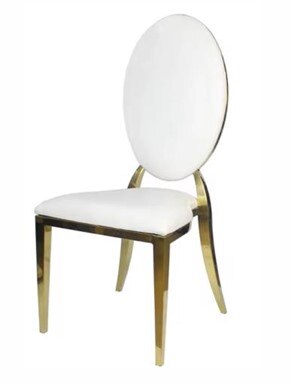 | Banquet Chair At The Comfort Seating, we focus on both aesthetics and functionality. View product → |
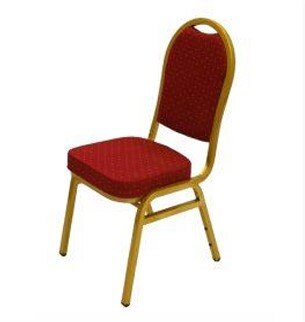 | Banquet Chair At The Comfort Seating, we focus on both aesthetics and functionality. View product → |
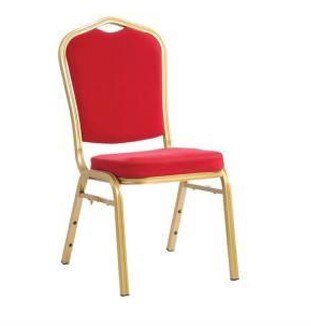 | Banquet Chair At The Comfort Seating, we focus on both aesthetics and functionality. View product → |
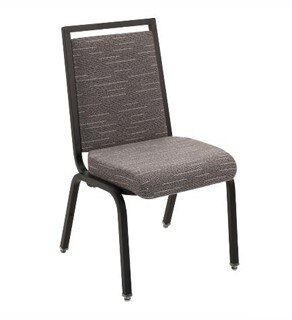 | Banquet Chair At The Comfort Seating, we focus on both aesthetics and functionality. View product → |